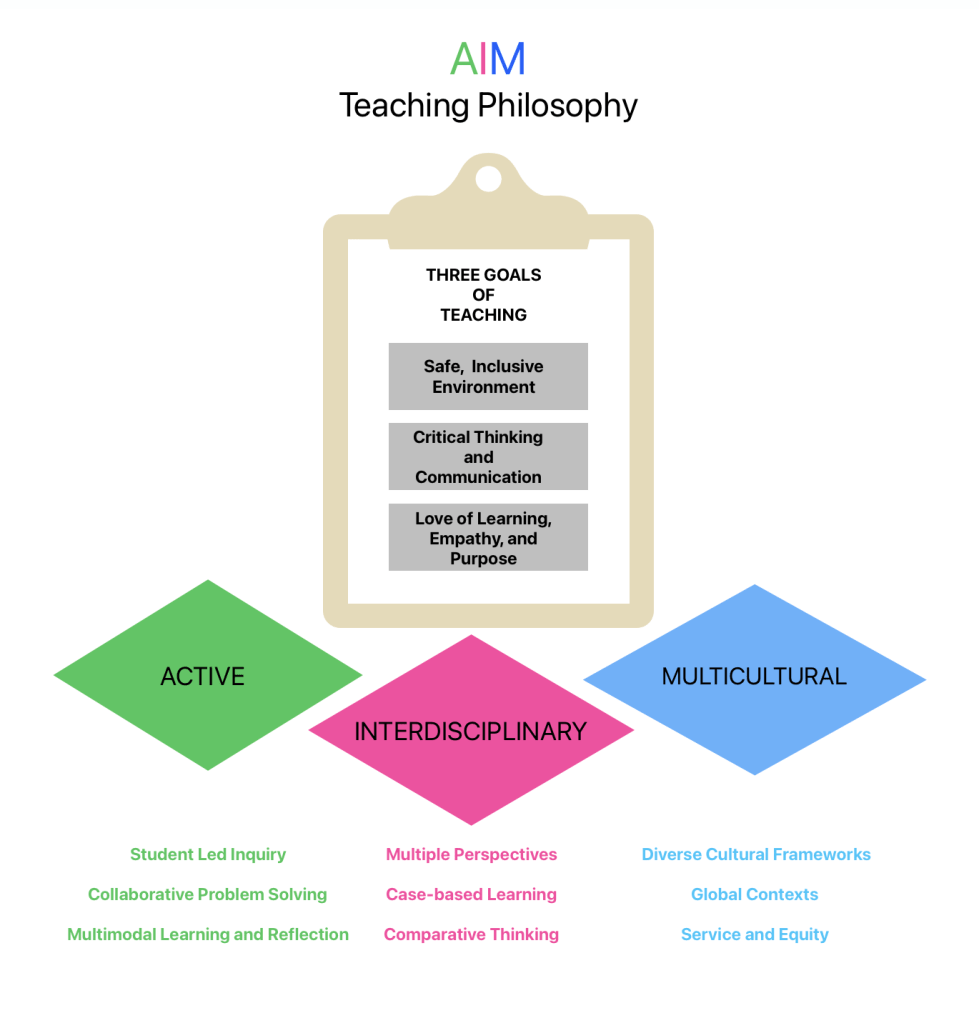
My AIM teaching philosophy is built around three goals: creating a safe and inclusive classroom, developing critical thinking and communication skills, and fostering a love of learning grounded in empathy and purpose. Education should help students become thoughtful, confident, and engaged members of their communities.
A safe and inclusive classroom is the foundation for intellectual risk-taking. Because students learn best when they feel both supported and challenged, I work to create an environment where they can listen carefully, consider perspectives different from their own, and contribute thoughtfully to discussion.
My education at Northfield Mount Hermon taught me that a classroom should cultivate both intellectual and moral qualities, and that education must serve a social purpose beyond individual growth. The Harkness tradition at Phillips Exeter has influenced me to integrate these goals within a discussion-based classroom where speaking requires courage, listening requires compassion, and understanding requires empathy. These values shape every practical choice I make as a teacher.
My teaching is discussion-based, grounded in primary sources, and centered on analytical reading and argumentative writing. Influenced by my experience teaching at Brown University, Towson University, and independent schools, I design classes as collaborative explorations rather than lectures, and when possible, I create opportunities for students to lead. Students work with texts, historical documents, images, music, and other cultural materials in order to ask questions, make connections, and support arguments with evidence. To help students build mastery, I break complex tasks into component skills such as close reading, source analysis, discussion, and writing, and help them integrate these skills into larger historical arguments and projects. My experience teaching writing, coaching athletics, and leading in wilderness settings has deepened my ability to differentiate instruction and reach students across a wide range of learning contexts.
The “AIM” approach reflects the methods I have found most effective in pursuing these goals.
Active: Students learn through discussion, case studies, projects, short presentations, and collaborative inquiry. I use scaffolded practice, opportunities for revision, and timely feedback so that students can build mastery over time and develop confidence in their abilities.
Interdisciplinary: I connect history, literature, music, media, and culture so that students can see how ideas move across subjects and through time. I use concept maps and comparative frameworks alongside graphic organizers and traditional note-taking to help students recognize patterns and connect ideas across fields. Drawing on my background in sociology, anthropology, religion, cultural studies, literature, and music and media, I am able to meet students across a range of interests and help them see history through multiple lenses.
Multicultural: I emphasize global and comparative perspectives that help students understand the diversity and complexity of human experience. I want students to draw on their own backgrounds, experiences, and prior knowledge while also learning to question assumptions and become more comfortable with new perspectives.
For example, in history and humanities courses, I often use case studies that ask students to compare different societies, movements, or historical moments. In one lesson, students examine how music shaped both the U.S. civil rights movement and youth movements in prewar Germany, asking why similar forms of expression could serve such different purposes. Such comparisons encourage students to think critically, recognize complexity, and see the connections between culture and history. Whenever possible, I give students meaningful choices in topics, sources, or forms of presentation because motivation is strongest when students feel ownership over their learning.
I believe in setting high expectations while providing multiple pathways to success. Students bring varied strengths, learning styles, and forms of prior knowledge that can either help or hinder learning, so I often begin units with discussion, reflection, or brief diagnostic activities. My experience teaching students with ADHD and other learning differences has reinforced the value of clear structure, collaborative work, visual tools, and project-based learning, not only for diverse learners, but for all students. Ultimately, I want students to become self-directed, self-motivated learners who can monitor their progress, seek feedback, revise their work, and adjust their strategies over time.
Beyond the classroom, I enjoy participating in the broader life of a school community. My work as a coach and mentor has shaped my belief that education is about more than academic achievement. Schools should help students develop empathy, resilience, responsibility, and a sense of purpose. Whether I am teaching, advising, or coaching, my goal is to help students grow into compassionate, engaged, and community-minded people.

