New Post for Today
Gabi Guedes has a new album!
I was lucky enough to study Afro-Brazilian percussion, rooted in Candomblé traditions, with Gabi in 2010 in Salvador da Bahia, Brazil.
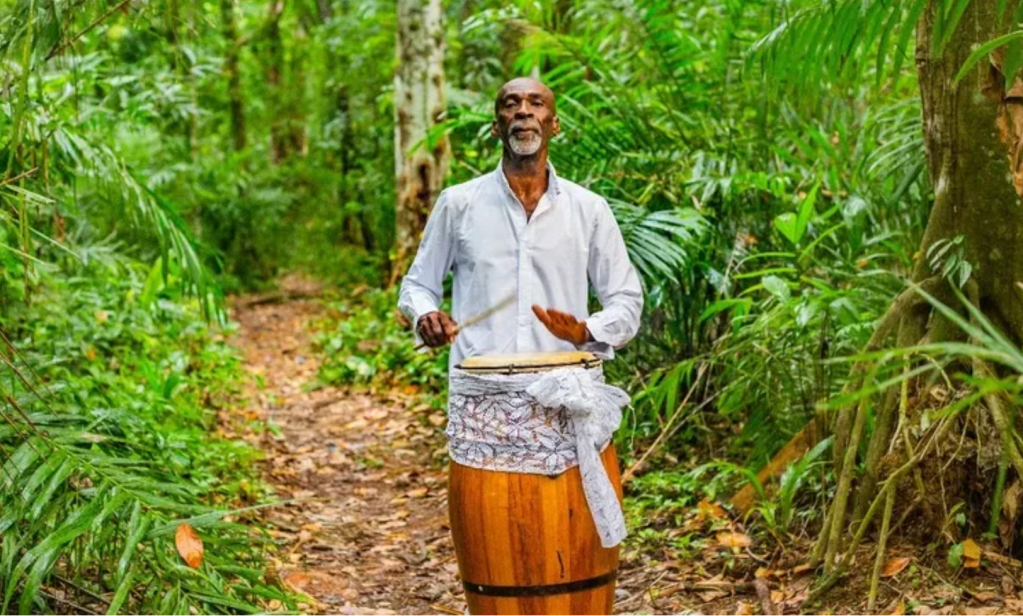
I (google) have translated some of a recent interview about the record, which can be found here: https://www.brasildefato.com.br/2024/03/30/com-mais-de-50-anos-de-carreira-percussionista-gabi-guedes-lanca-seu-primeiro-album/
Brasil de Fato Bahia – Gabi, you have a career in music spanning over 50 years, having played with icons of Brazilian and foreign music.
What do you bring from this career to this first recorded album, Matriarcas?
Gabi Guedes – Along the way, you gather many things, you collect. You learn from one person, from another, you save memories, you save stories of struggle, resistance, legacies. And that is what really made this puzzle, and I gathered all this material. I didn’t even think I could record an album!
When I started being invited to teach workshops, both here in Brazil and abroad, I always talked about atabaque players. I always talked about these black quilombolas, candomblé practitioners, macumbeiros. I saw that these people were always connected to their ancestry, even when dealing with different nations, that is, different ways of worshiping the Orixá, or Nkisi, or Caboclo, or Entity.
And what was the process like of taking this sound, this knowledge of the terreiros, to an album to be played for the public, outside the sacred space?
Once a computer arrived at our house, we started working on the computer with music programs. One day, my nephew Felipe Guedes and I put an application on the computer for a piano, and I thought: wow, this is going to happen. So I sang a song to Oxalá. And we started looking for it on the piano and we found it.
And I said to him: “Come here, how would a bass player, a musician behave within a theme like this, a song he’s never heard? A feeling he’s never heard?” Because you go to music schools and find several musicians, several categories, but if you say the name of a Candomblé tune or a melody, they don’t know. They don’t know! Because discrimination, prejudice, racism, always come first, prevailing. People didn’t have or don’t have that time to see, imagine or hear these things.
And then we started distributing this stuff right here at home, on the piano. We made one. Later, when we prepared this whole song on the piano, on the computer, we started playing around with the other elements. One day, Evanailton Bispo, a saxophonist who passed away some time ago, a very, very good musician, came to our house and played. And he wrote everything for the sax.
And then the work began like this. I started to create other ideas and invite musicians to be part of it. The pianist, how is the pianist going to play this theme? How is he going to think? I have to experience it with him, teach him how to sing it, teach him where the breathing of the song is, teach him about a circular key… I kept doing this experience until this Pradarrum work was born.
When I came up with this idea of exploring this work, the late Letieres [Leite] was also working with Rumpilez, and he invited me to be a member of the orchestra. And we met several times and talked about the beats, talked about how it could be. He was always writing things down. And I stopped working with Pradarrum for a while to continue these trips with the Rumpilez orchestra. I learned a lot, I was also able to teach a lot, I was able to pass on a lot of my experience, my learning from the Candomblé terreiros.
Gabi, tell me a little more about this side of being a teacher, about teaching. You’ve been a teacher for many years, you’ve taught a lot of people, haven’t you?!
It all started here at Gantois’s terreiro. I was still a teenager, maybe 16 years old, and I already understood a little about the fight, right? Because I worked in a mechanic’s shop nearby, and I studied. And I remember that people would come who wanted to learn how to play the atabaques, and no one had the patience to teach them. Foreigners started coming, and people would ask if I could teach. And I would answer: no, I can’t teach, but I can show them how it’s done. I wanted to teach them step by step, from scratch, I taught them how to do things, and they liked it, sometimes they paid me, sometimes they brought me gifts like instruments. And I started to build this familiarity.
I remember that the late Lindemberg Cardoso came to my house looking for me. I never dreamed of it! I had a thing with the School of Music, with UFBA… until it passed. And I started teaching these people, and then Professor Paulo Lima came too. We also did some research when he was traveling to Europe to do a master’s degree or a doctorate. It was great to study about the beats, so that the people would have something to take back to Europe, as well, as ancestry, as Afro-ancestry.
Because it’s not just about arriving in Europe playing Brazilian stuff. Bossa nova has been tired for a long time. So, the people had to come with something new. And what was the new thing? The new thing was that there was discrimination, that nobody liked it, that playing for the devil was a black thing. So you start to create your own defense too. When these [European] people arrive, it’s not just smiles. When we bring these people to the “aquilombamento” space, they arrive with “appropriation”.
Returning to the album, it is named after Matriarchs, figures so important to the axé people. How important are matriarchs in your life and musical journey?
When I thought about this thing about the song, the melody, the connection with these things, I thought of something softer, more beautiful, to honor the mothers, the matriarchs. In other words, I thought about several mothers, several people here at the Gantois terreiro and from several other terreiros here in Salvador, who embraced me, who welcomed me, who took me to the Saint’s room, who embraced me when I was manifested, who supported me, who taught me how to respect, taught me how to ask permission to enter and ask permission to leave as well.
So I started working on this album to pay homage to them. I call it Matriarchs, because it is a work aimed at mothers. Mothers like my Iyalorixá, my mother of Saint, that Mãe Menininha do Gantois, who I had the pleasure, the honor of living with her since my childhood, when I left the womb of my biological mother living right here next to the terreiro, I already infiltrated myself there.
My grandmother, Maria Filipa, was a daughter of Santo, also from the Gantois terreiro, and was the one who took me there for the first time. But before I got there, I was already playing in the back of the house with the can, making those drums with the cans, my mother, a native of Cachoeira, singing samba so we wouldn’t go out on the street. She sang, and I played. “My son doesn’t need to go out on the streets. He’s going to play here with me.” And that makes this connection with the sound of the atabaques until I get there. And then, over time, I saw how necessary it is to preserve these touches.
In addition to the Gantois terreiro, did you also frequent other terreiros? Did you learn in other houses too?
There have always been terreiros around here, there in Garcia, there in Vasco da Gama, several terreiros. And I always liked going to Candomblé on the weekends. Ah, I had to go there to play, be there with the guys, meet everyone and learn how to play. And to know who was playing here.
I’ve always been an observant guy, never a talker, but a real observer. I always went to the terreiros, the person was playing there. The ceremony was going on, I was standing there, participating in the ceremony, but listening to the guy play. Then, I’ll play that all the time, even if there’s no Lê and Rumpi [drums], with my eyes closed and watching someone dancing in front of me. There you are connected. You don’t even need to call a daughter of Saint to dance, nothing, because I know all the dance moves.
And I remember that the older people at the terreiro commented that once, there was a ceremony going on, and I was playing the atabaque. And my grandmother Menininha sent for the person who was playing the atabaque. Then I entered the room like this: “Ago, excuse me, mom”. And my mother [asked]: “Was it you who was playing the atabaque? Very good. Go back and play it again, because it’s been a long time since I heard an atabaque played like that.”
And I went for it! Here in front, the late Bira Reis lived, he was a luthier, he made berimbau, calimbas, gourd saxophones… I heard the guys playing from here at home, I climbed the genipap tree to look at the back of his house. And my mother said: I don’t want you in that house. When I went to school, I passed by the door of the house, and I thought: I have to go into this house one day. Then I got it one day. I had grown up more, I was already working here in the workshop. I joined, arrived, became friends with Bira Reis, so much so that he moved to Pelourinho, I started teaching at his school, before he passed away.
Edited by: Gabriela Amorim
 nickreederacademic